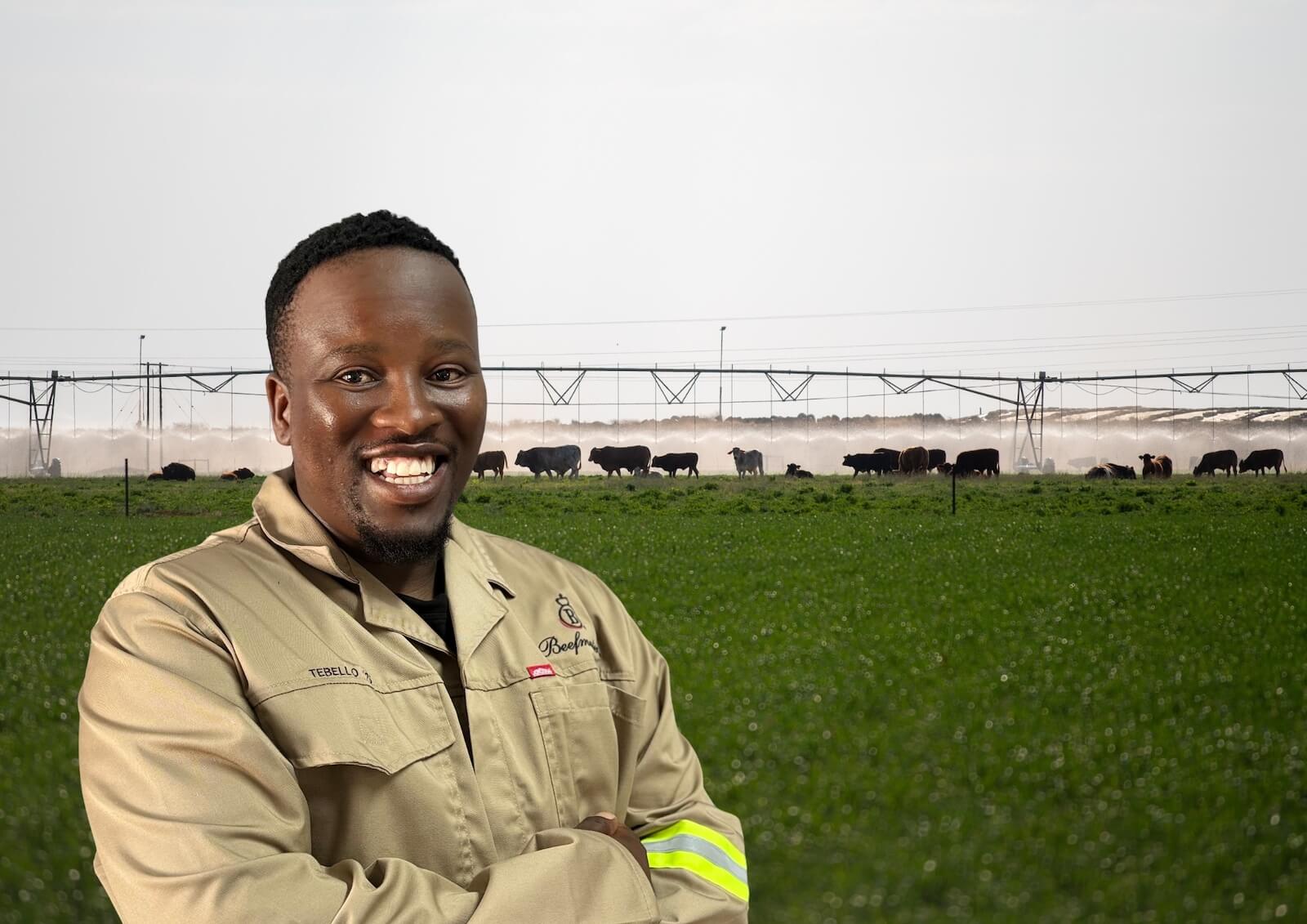
Born and raised in Senekal in the Free State, Nonyane joined Beefmaster Group in 2015 as a general labourer. His career progression reflects determination, continuous learning, and strong employer support.
“I started as a labourer, then became a pivot operator, and today I’m a team leader,” he says.
Over the years, he completed several learnerships in Generic Management and Business Administration, and, with the support of Beefmaster Group, went on to earn a Bachelor of Commerce in Accounting from the Richfield Graduate Institute of Technology.
Today, his responsibilities include:
- Implementing irrigation strategies to improve crop yields
- Maintaining and optimising centre-pivot irrigation systems
- Leading and managing a team of irrigation operators
“Every day brings new challenges,” he says. “But solving complex problems and overcoming obstacles is where real growth happens.”
Why Improving Food Security Matters in South Africa
In a country where dietary diversity and nutrition remain pressing challenges, Nonyane’s work has a far-reaching impact.
According to the 2025 South African Food Security Index, food security has shown slight improvement compared to 2024, largely due to declining food inflation. However, millions of South Africans still face hunger or inadequate nutrition:
- 80.8% of households consumed more than six food groups
- Nearly 20% of households consumed too few food groups
- The Free State recorded the lowest dietary diversity, with 49.3% of people consuming three or fewer food groups per day
- The Northern Cape followed closely, at 42.2%
Globally, the challenge is just as severe. According to the World Health Organisation’s State of Food Security and Nutrition in the World report, food security continues to decline across much of Africa. An estimated 307 million people – 20% of Africa’s population – experienced hunger in 2024.
Feeding Families, Strengthening the Future
“I’m proud to work for a company that feeds families,” says Nonyane. “Knowing that my work helps ensure access to nutritious food is deeply fulfilling and motivates me to keep improving.”
His ten-year journey at Beefmaster Group demonstrates how individual dedication, skills development, and corporate purpose can align to address one of South Africa’s most complex challenges. As the country continues to work toward a more food-secure future, it is people like Tebello – supported by responsible agricultural businesses – who are helping to nourish the nation, one drop of water at a time.